
Ask five contractors whether you should frame with steel studs or wood and you’ll get six opinions. Here’s the truth from a crew that installs both, daily, across residential and commercial jobs throughout the Greater Toronto Area: the right framing material depends on what you’re building, where you’re building it, and what’s going on the other side of that wall.
Key Takeaways
- Steel stud framing dominates commercial construction and is increasingly common in GTA basements and custom homes.
- Wood framing remains the default for above-grade residential load-bearing walls in Ontario.
- Steel studs don’t rot, warp, or feed mould, a massive advantage for below-grade environments.
- Wood studs are easier to modify on-site and cost less for small-scale residential framing.
- The best projects often mix both: wood for structure, steel for moisture and precision.
What Is Metal Stud Framing?
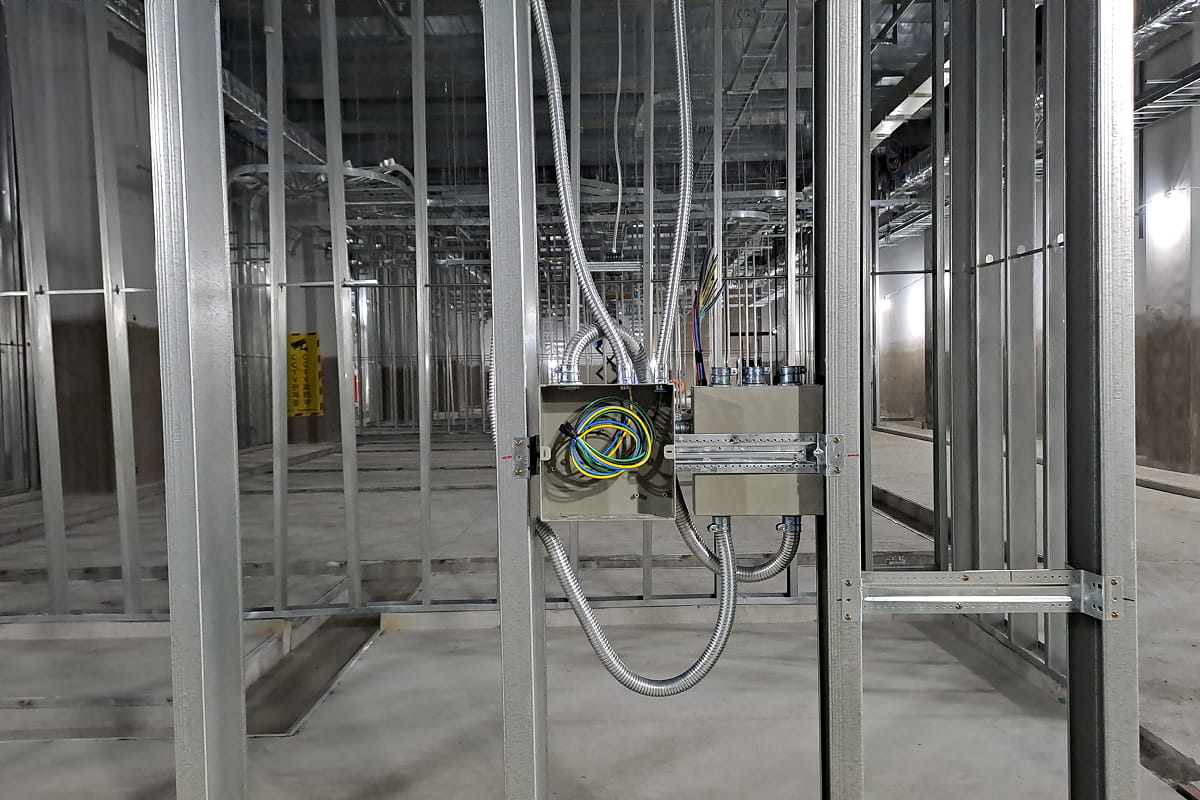
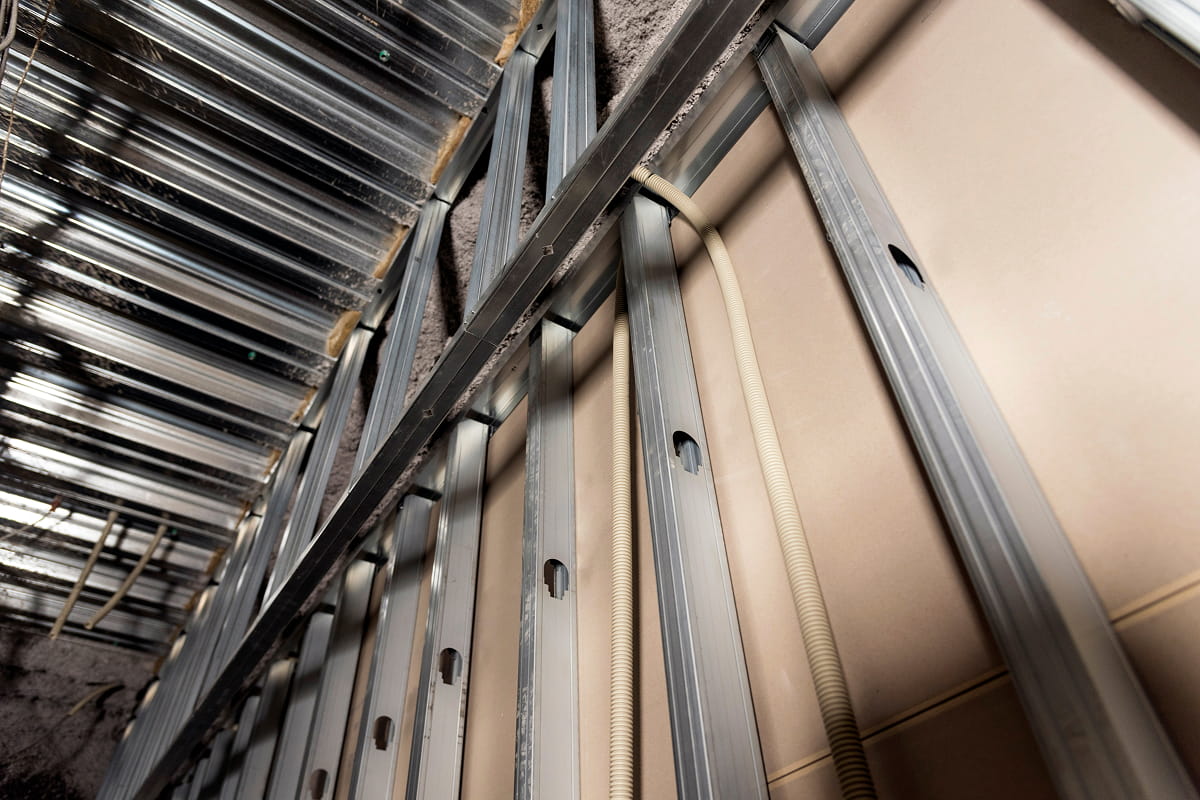
Metal stud framing, or cold-formed steel (CFS) framing, uses galvanized steel C-channels as studs and U-channels as tracks. Steel studs are manufactured to precise dimensions. A 3-5/8″ steel stud is exactly 3-5/8″ every time, with no knots or twists.
On the residential side, steel studs are most commonly used for basement finishing, interior partition walls, and bulkheads, anywhere a wall needs to go up straight and stay moisture-resistant.
What Is Wood Stud Framing?
Wood framing uses dimensional lumber (typically SPF in Ontario). The Ontario Building Code is largely built around wood-frame construction for housing. Wood’s greatest strength is its versatility; it handles compression loads exceptionally well and is easily modified with standard tools.
Is Metal Stud Framing Stronger Than Wood?
It depends on the “type” of strength. For load-bearing walls that carry the weight of a house, wood is the practical default. For non-load-bearing partition walls, steel studs offer superior dimensional consistency, leading to a much flatter drywall installation.
Metal Studs vs. Wood Studs: Full Comparison
| Factor | Metal (Steel) Studs | Wood Studs |
|---|---|---|
| Consistency | Factory-precise; no crowns or twists | Natural variation; requires shimming |
| Moisture | Immune to rot and mould | Susceptible to moisture damage |
| Fire Resistance | Non-combustible | Combustible |
| Load-Bearing | Requires engineering for residential | Code-prescriptive for houses |
Why Do GTA Basements Benefit from Steel Stud Framing?
Basements are where steel earns its keep. A GTA basement foundation draws moisture year-round. While wood can swell and grow mould, steel studs don’t absorb a drop. When combined with spray foam insulation, you create a flat, true wall surface that won’t warp as the seasons change.
When Does Wood Framing Make More Sense?
Wood is the smarter choice for load-bearing walls in additions or new home builds. It also avoids “thermal bridging” on exterior walls, which can reduce your insulation’s effectiveness. Wood is also simpler if you plan to mount heavy items like TVs or cabinetry without pre-installed blocking.
Can You Mix Metal and Wood?
Absolutely. We often use wood for structural walls and switch to steel for interior partitions and bathroom surrounds. This is common in many of our projects in the GTA. A framing contractor experienced in both materials can coordinate these transitions seamlessly.
How to Choose: A Practical Decision Framework
- Is it load-bearing? If yes, use wood.
- Is it below-grade? For GTA basement projects, steel is the winner.
- Is fire-rating required? Steel is often required in commercial or multi-unit builds.
Ready to Get It Done Right?
Centennial Drywall frames with both steel and wood across the Greater Toronto Area. We recommend what’s right for the job, ensuring your foundation is as solid as the finish. Contact us for a free quote today.
SOURCES CITED:
Ontario Building Code, Part 9. https://www.ontario.ca/page/ontarios-building-code
Natural Resources Canada, Steel Framing Performance. https://www.nrcan.gc.ca