

You might assume commercial and residential drywall are similar but that’s not always the case. The drywall itself can be similar, but the way it’s used and installed can be quite different depending on the property and its requirements.
For example, a drywall project in a GTA home is very different from one in an office, retail space, or other commercial property. Sound control, durability, framing, finishing, fire requirements, and the size of the project can all affect the drywall system we recommend.
So, do you actually need different drywall for a commercial property? And is commercial drywall always stronger or more expensive?
Let’s look at the key differences so you can make the right choice for your project.
Key Takeaways
- Commercial and residential drywall are not completely different products. The main difference is how the drywall system is chosen for the project.
- Commercial projects cover larger areas and have more requirements. Residential projects are usually smaller and may focus on individual rooms, basements, or additions.
- 1/2-inch drywall is common in many homes.5/8-inch drywall may suit specific project requirements.
- Both residential and commercial projects can require moisture-resistant, impact-resistant, acoustic, or fire-rated drywall.
- A level 4 finish is suitable for many residential applications. Commercial projects can require a higher level of finish.
- Wood framing is common in homes. Metal framing is common in commercial interiors.
Is Commercial Drywall Different from Residential Drywall?
No, not exactly. As we explained above, the drywall board itself can be similar, but the way it is used can be very different. If we talk about commercial projects, they usually have more specific requirements based on the type of building, how the space will be used, and how the walls need to perform.
For example, in your home, you may need better sound control between bedrooms or shared walls. In an office, you may need to limit noise between meeting rooms or workspaces. Similarly, in a retail space, you may need drywall that can handle more bumps and day-to-day wear and tear.
That’s why we don’t recommend choosing drywall simply because a project is labelled commercial or residential. We look at the space, the wall assembly, the level of use, and the project requirements before deciding what actually makes sense.
Commercial vs. Residential Drywall: What Are the Main Differences?
Project Size and Scope
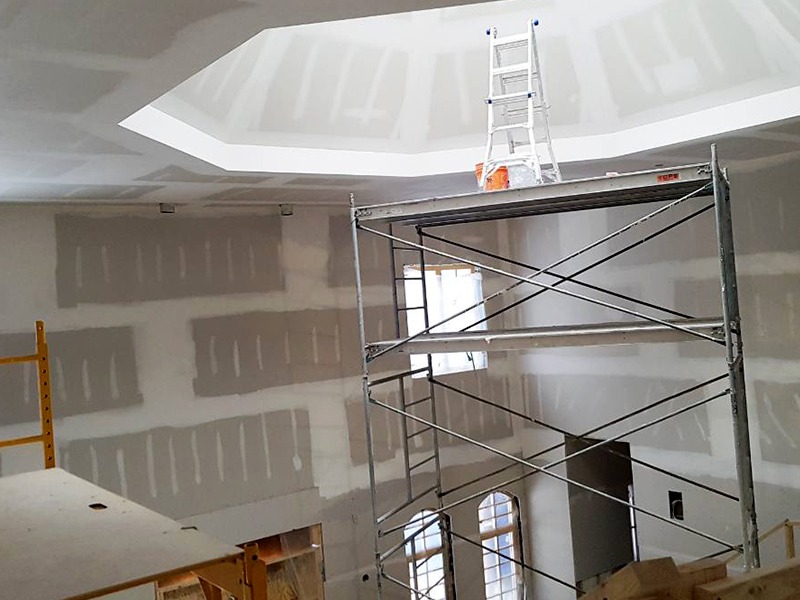
Residential drywall projects are usually smaller in scale. You may be finishing a few rooms, a basement, or an addition. But commercial projects are bigger as they can involve an entire office, retail space, restaurant, or multi-unit building, with much larger wall and ceiling areas to cover. That difference in scale can also affect project planning, installation, and schedule.
Durability and Impact
Walls in a typical home deal with normal household use. Commercial spaces see much more traffic such as people moving furniture, equipment being brought through corridors, or customers and employees moving around throughout the day. In these areas, we may recommend drywall or wall assemblies that provide better resistance to dents and impact, depending on the space.
Materials
Basic gypsum board is used commonly in commercial and residential applications, but commercial projects can call for different products or assemblies depending on the space. This can include standard board, moisture-resistant board, impact-resistant board, acoustic systems, or fire-rated products. Thickness can also vary depending on the application. For residential applications, 1/2-inch drywall is common, while 5/8-inch drywall may be used when the project requires a higher level of performance.
The key point is that commercial drywall doesn’t automatically mean you need a completely different material. The right choice depends on what the space needs.
Installation Techniques
For residential drywall projects, the installation is usually more straightforward because the spaces are smaller and the layouts are less complex. Commercial projects can involve larger areas, higher ceilings, metal framing, multiple layers of drywall, and more coordination with electrical, plumbing, and HVAC trades. That’s why the installation can be more involved and requires more planning.
Sound Control
Sound control can matter in both residential and commercial properties. As we mentioned earlier, you may need sound reduction between bedrooms or shared walls in your home. In an office, you may need to control sound between meeting rooms or workspaces. That’s where the drywall you choose, along with the framing, insulation, and number of layers, can make a difference.
Framing
Wood framing is common in residential construction, although metal framing is also used in certain applications. Commercial projects commonly use metal studs, especially for interior partitions. The framing choice can influence the wall’s strength, layout, sound performance, and overall construction process.
Building Codes and Regulations
Residential project work has to meet specific building code requirements. For example, if you’re finishing a basement, adding a new wall, or changing your home’s layout, the drywall assembly may need to meet certain fire or other building requirements.
Commercial projects also have to meet the applicable building codes, but there can be more requirements, depending on the overall project scope. That’s why we always look at the requirements before deciding which drywall system is right for your space.
Speciality Drywall
A commercial drywall project can include areas that require specialty products, such as moisture-resistant, impact-resistant, or fire-rated drywall systems. However, residential projects can also need these products depending on the space. For example, a bathroom may need moisture-resistant drywall, while a garage or high-traffic area may benefit from an impact-resistant drywall system. It all comes down to where the drywall will be installed and what the wall needs to handle.
Finishing Requirements
Drywall finishing is what gives the walls and ceilings their final smooth look. It involves taping the joints, applying joint compound, and sanding the surface before painting. The requirements can vary based on the size of the walls, lighting, and the type of finish being applied. Drywall finishes range from level 1 to level 5, and each level is suited to different applications. For most residential spaces, a level 4 finish is common, while some commercial spaces may require a higher level of finish.
Does Commercial Drywall Cost More Than Residential Drywall?
Yes, commercial drywall can cost more but it depends on the project. We can’t finalize the price based solely on whether the project is residential or commercial. The type of drywall, framing, number of layers, ceiling height, project size, and finishing requirements can all influence the total cost.
Residential projects can also become more expensive if the project includes specialty products or a higher level of finishing. That’s why we recommend the full scope of work before providing a final price.
Can You Use Commercial Drywall in a Residential Project?
Yes, you can if your project calls for commercial-grade or specialty drywall products. For example, you may need impact-resistant drywall in a busy area, better sound control between rooms in your home, or fire-rated wall assembly. But keep one thing in mind – commercial-grade products aren’t always better for a residential project. If standard drywall can meet the needs of the space, using a specialty product may only add to your costs without giving you any real benefit.
What Type of Drywall Does Your Project Need?
For a home, standard drywall may be suitable for bedrooms, living rooms, and other areas with normal use. However, specialty products may make sense if you need better moisture, impact, sound, or fire resistance.
For commercial spaces, the right drywall decision comes down to the type of business, how much traffic the space gets, and the requirements of the building.
At Centennial Drywall Inc., we help you determine which drywall system makes sense for your project, so you don’t end up paying for a product you don’t need.
What Should You Ask Your Drywall Contractor Before Starting?
A few questions are worth asking before the work starts, so you know what you’re paying for and what will be installed.
- What type and thickness of drywall will you use?
- Does the space need moisture-resistant, impact-resistant, acoustic, or fire-rated drywall?
- What type of framing and finishing will you use?
- Are the drywall materials, installation, taping, mudding, and sanding included in the quote?
- Are there any building code requirements we need to consider?
Commercial vs. Residential Drywall: The Bottom Line
The differences between commercial and residential drywall come down to more than just the type of board you use. Everything from the project type and scope to the materials, framing, installation, and finishing can influence the decision. When choosing between the two, don’t just focus on the price or the type of property. Think about how the space will be used and what you need the walls to handle.
For the best guidance, talk to Centennial Drywall Inc. We can help you choose the right drywall system based on your property, the space, and what your project requires.
Frequently Asked Questions
Is commercial drywall stronger than residential drywall?
Not necessarily. Commercial projects may use specialty drywall or different wall assemblies based on the space, but commercial drywall isn’t automatically stronger than residential drywall.
Is commercial drywall more expensive than residential drywall?
It can be, but the total cost depends on the project size, materials, framing, installation, finishing, and other requirements.
Can you use commercial drywall in a residential project?
Yes. Commercial-grade or specialty drywall can be used in residential projects when the space requires better sound control, impact resistance, or other specific performance.
What thickness of drywall is common for residential projects?
1/2-inch drywall is common for many residential applications. You may need 5/8-inch drywall for projects with specific performance or wall assembly requirements.